Oratomic Raises $300M Series A to Build a Fault-Tolerant Quantum Computer
Oratomic, a quantum computing startup based in South Pasadena, California, has raised $300 million in a Series A round. The company announced the round on July 7, 2026. ARCH Venture Partners, Spark Capital and Khosla Ventures co-led it, and the company did not disclose a valuation. Its stated goal is to build a quantum computer that can correct its own errors. The $300 million is the company's first round, four months after it came out of stealth in March 2026.
The Investors
Bezos Expeditions, Index Ventures, General Catalyst, Lowercarbon Capital, Bain Capital, Formation, Nebular, and David and Scott Aaronson took part, according to The Quantum Insider. Other backers include Les Kohn, Baiju Bhatt, Infleqtion, Genius Ventures, 7i Capital and Global Frontier Investments. The company's own announcement also lists Wilson Hill and Caltech.
Vinod Khosla wrote on X that Khosla Ventures made its largest initial investment yet in Oratomic, as it had done with OpenAI, The Quantum Insider reported. Dealroom also noted the OpenAI comparison.
"Our objective is straightforward: build a fault-tolerant quantum computer," the company wrote. "We are not pursuing intermediate products or commercial systems along the way."
The Technology and the Team
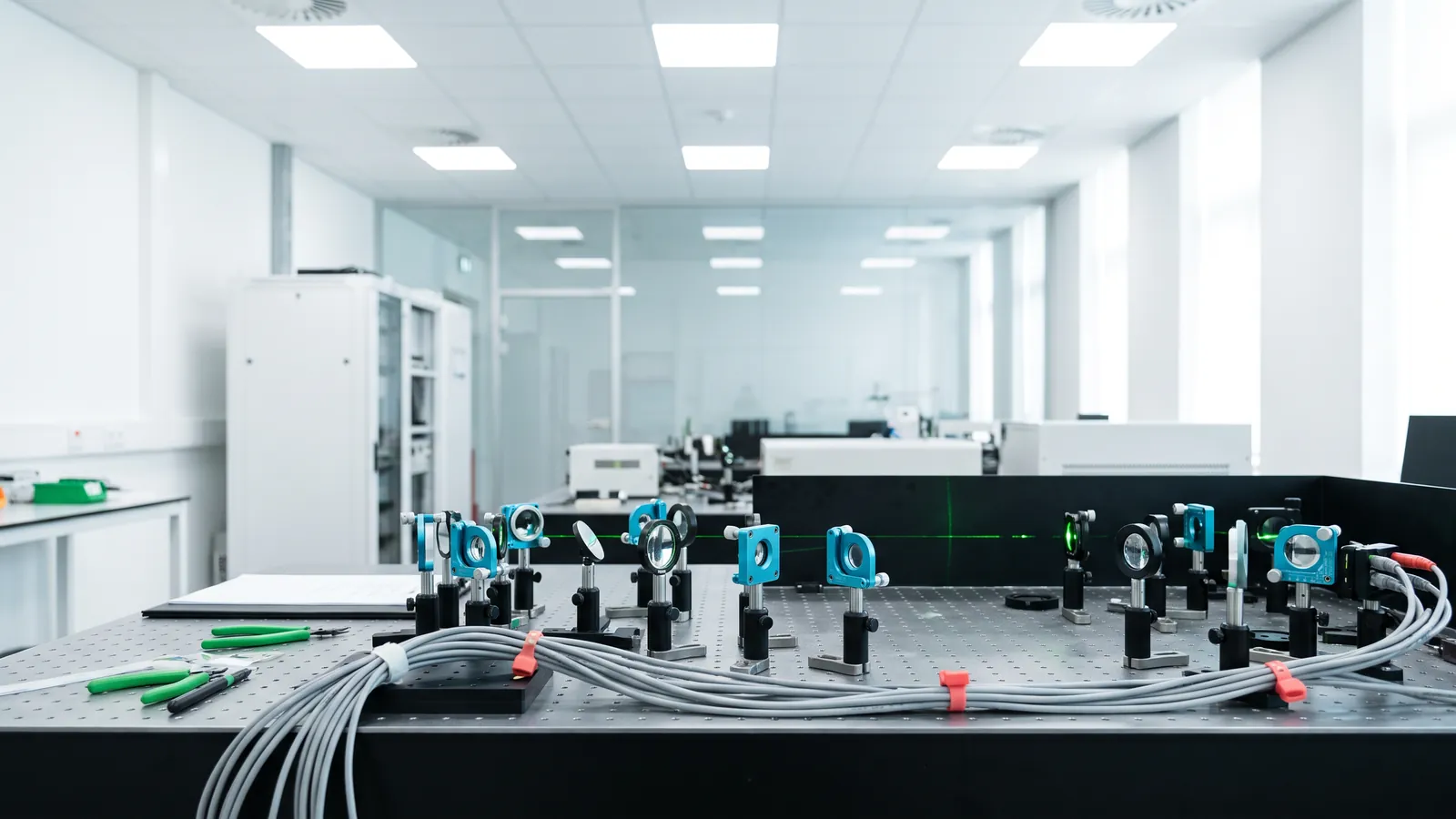
Oratomic builds neutral-atom quantum computers. Single atoms are held in place by focused laser beams, often called optical tweezers. According to Quantum Computing Report, these atom arrays can be rearranged, and qubits can be moved during a computation to form flexible connections. The outlet contrasts this with superconducting and trapped-ion systems, which it says rely on fixed physical connections.
The company's main claim is about scale. Research with Caltech scientists suggests a useful machine might need about 10,000 reconfigurable neutral-atom qubits, far fewer than the millions often estimated before, The Quantum Insider reported. TechCrunch reported the company's figure as roughly 10,000 to 20,000 qubits.
According to Oratomic, co-founder Manuel Endres has already demonstrated arrays of roughly 6,000 trapped atomic qubits, The Quantum Insider reported. CEO Dolev Bluvstein leads the company. The founding team includes researchers from Caltech, UC Berkeley, Harvard, Amazon and Google, including the physicist John Preskill.
Bluvstein has said the team once believed commercially useful quantum computing was far away, and that its recent research changed their minds. He has also called it plausible, though not guaranteed, that a fault-tolerant machine could exist by the end of the decade. The company adds that it is building AI systems to automate its own research and the design of the computer.
Market Context
A large fault-tolerant machine could run Shor's algorithm, which can break widely used public-key encryption. The Quantum Insider notes that governments and standards bodies are already planning moves to post-quantum cryptography, often with targets around 2035. Crunchbase data shows more than 70% of global startup capital in the second quarter of 2026 went to AI-focused companies.
According to The Quantum Insider and Dealroom, Oratomic plans to use the new money to:
- Expand quantum hardware fabrication
- Speed up research on fault-tolerant architecture
- Grow its physics and hardware engineering teams
The company says it wants to hire generalists, scientists, engineers and technicians, and that "a background in quantum computing is not required."
Sources
CIBA Editorial
Author of this post